
Optical switch | Mechanical and MEMS

What is an optical switch?
An optical switch (optical switch) is a device with one or more selectable transmission windows.
which can perform mutual conversion or logical operation on optical signals in optical transmission lines or integrated optical circuits.
In fiber optic transmission systems, optical switches are used for switching between multiple monitors, LAN, multiple light sources, detectors, and protected Ethernet.
In the fiber optic test system, it is used for fiber optics, fiber optic equipment testing and network testing, and fiber optic sensing multi-point monitoring systems.
According to the number of input and output ports of the optical switch,
It can be divided into 1×1, 1×2, 1×N, 2×2, M×N, etc., and they have different uses on different occasions.
Its application scope mainly includes the protection switching system of optical network, light source control in optical fiber test,
real-time monitoring system of network performance, test of optical device, construction of switching core of OXC equipment, optical add/drop multiplex, optical test, optical sensor system, etc.
Using a prism (or reflector) to switch the optical path technology,
The principle is to control the displacement of the prism based on the power on/off of the relay.
The relay type is divided into self-locking and non-self-locking.
The self-locking optical switch will maintain the optical path state after power-on or power-off.
The non-self-locking optical switch will maintain one optical path state when the power is off
and switch to another optical path after the power-on state.
When the power is off, it will return to the state of the optical path when the power was off.

// 1x2 Mechanical Optical Switch //
The 1x2 fiber optic switch connects optical channels by directing or blocking an incoming optical signal into the output fiber.
This is achieved using a patent-pending opto-mechanical configuration and activated via an electrical control signal.
A latching version preserves the selected optical path after the drive signal has been removed.
while the non-latching versions default to either the open or closed state when power is removed.
The switch has integrated electrical position sensors.
The new material-based advanced design significantly reduces moving part position sensitivity.
offering unprecedented high stability as well as unmatched low cost.

// 2x2B Mechanical Optical Switch //
The 1x2 fiber optic switch connects optical channels by directing or blocking an incoming optical signal into the output fiber.
This is achieved using a patent-pending opto-mechanical configuration and activated via an electrical control signal.
A latching version preserves the selected optical path after the drive signal has been removed.
while the non-latching versions default to either the open or closed state when power is removed.
The switch has integrated electrical position sensors.
The new material-based advanced design significantly reduces moving part position sensitivity.
offering unprecedented high stability as well as unmatched low cost.

// 2x2F Mechanical Optical Switch //
2×2F optical switch is the most commonly used one in the optical switch series, widely used in FDDI, optical node bypass, loop test sensing systems, etc.,
can also be combined with other types of optical switches to make the switching system more complete and flexible.
Switch the optical path by moving the optical fiber.
The principle is to control the displacement of the optical fiber through the numerical control motor.
Common mechanical 1×N optical switches belong to this type:
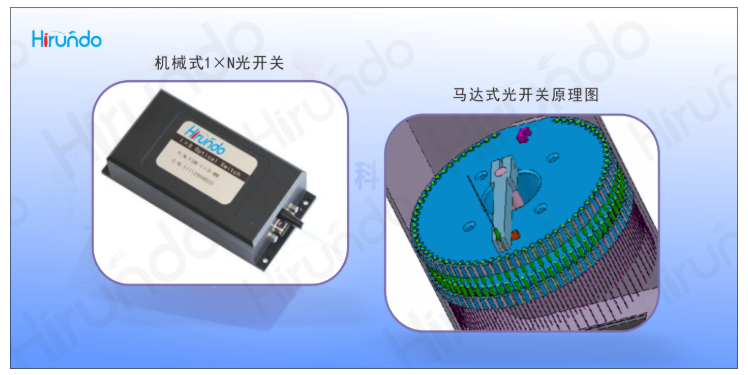

// 1xN Mechanical Optical Switch //
The mechanical optical switch has the advantages of low insertion loss and small size.
and is the ideal device for dynamic configuration of the plug-in multiplexer OADM,
cross-connector OXC, system monitoring and protection,
and the small package is easier to integrate into the high-density optical communication system, with locking and non-locking control types.
In recent years, the microelectromechanical optical switch has developed rapidly.
It is a new type of microcomputer-electrical-optical integrated switch produced by the combination of semiconductor microfabrication technology,
micro-optic and micro-mechanical technology.
It is a large-capacity switch.
The mainstream direction of optical network switch development.
MEMS (Micro Electro-Mechanical System) optical switch is to engrave a number of tiny mirrors on the silicon crystal.
Through the action of electrostatic force or electromagnetic force, the movable micro mirrors can be lifted.
rotated or moved, thereby changing the transmission of input light.
Direction to realize the function of the light path on/off.
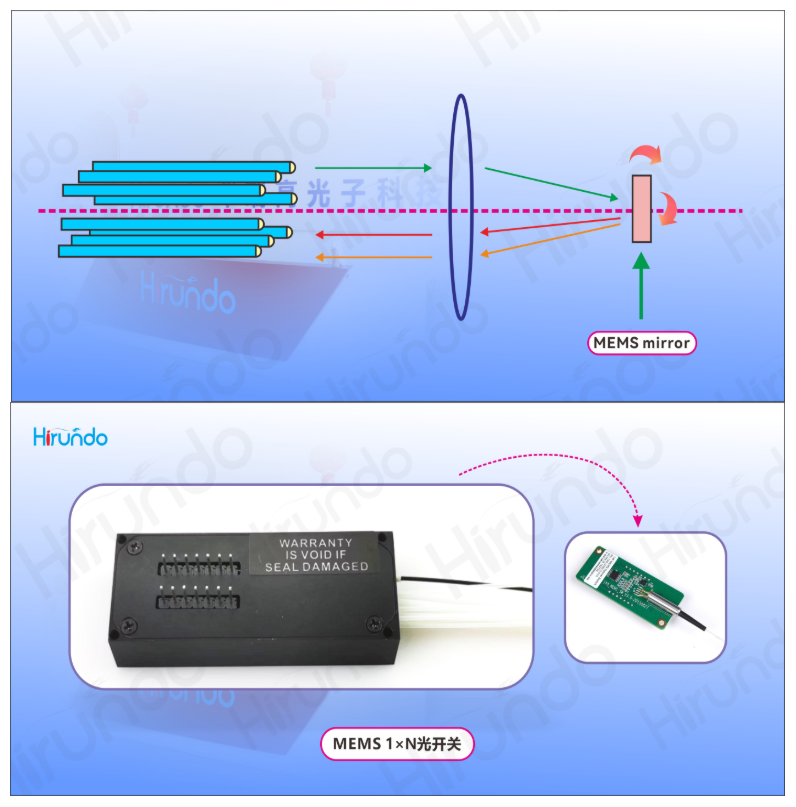
MEMS optical switches have obvious advantages over other optical switches
- Switching time is generally in the order of ms;
- Using IC manufacturing technology, small size and high integration;
- The working mode has nothing to do with the format, protocol, wavelength, transmission direction, polarization direction
and modulation mode of the optical signal, and can process optical signals of any wavelength;
- At the same time, it has the advantages of low insertion loss, low crosstalk, low polarization sensitivity, high extinction ratio
of mechanical optical switches and high switching speed, small size, and easy large-scale integration of waveguide switches.