
The "invisible hub" of optical communication: understand the fiber coupler and select the right core components of the network

The "invisible hub" of optical communication: understand the fiber coupler and select the right core components of the network
In modern optical communication networks, fiber optic couplers play a crucial role. It is like an invisible "traffic command", silently completing the distribution and combination of optical signals in scenarios such as 5G base stations, data centers, and optical fiber sensing, supporting high-speed and efficient information transmission networks.
1. What is a fiber optic coupler: the "traffic command" of optical signals
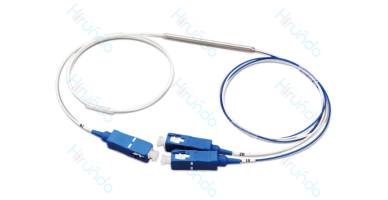
An optical fiber coupler is a passive optical device that can efficiently and stably transmit optical signals from one or more optical fibers to another or more optical fibers. Its core function is to realize the distribution (splitting) or combination (combination) of optical power while keeping the signal spectrum composition unchanged, which is the basic component for flexible signal scheduling and expansion in optical communication systems.
★ Core features
Passive design: no external power supply, simple structure;
Bidirectional reversible: the input and output ports are interchangeable;
Low Loss Transmission: The insertion loss of high-quality couplers can be as low as 0.1dB to ensure the quality of signal transmission.
2. Melt cone drawing technology: use the "micro-engraving" process to achieve precise distribution of light
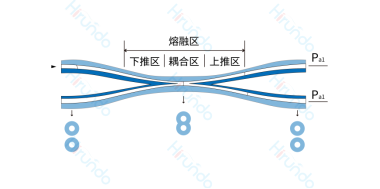
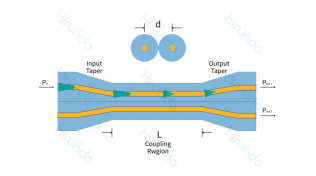
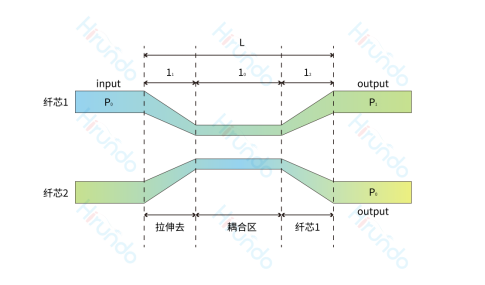
The fusion tapering technology is to form a double cone coupling zone by placing two or more fibers together, heating and melting them, and then stretching them. In this region, the light signal is exchanged through a gradient waveguide structure, and the splitting ratio can be precisely adjusted by controlling the stretch length. The fusion area of two optical fibers formed by fiber winding and melt stretching is called the coupling region, and its structure is shown in the figure below
3. Polarization Coupler: The "polarization soul" that guards the light signal
The bias-preserving coupler is made by the same melt taper drawing process. However, throughout the process, extreme precision is required to ensure that the polarization spindles of the two fibers (i.e., the reference axis in the direction of polarization of the optical signal) are accurately aligned and remain parallel. In this way, the composite waveguide structure formed in the coupling region can realize the distribution or combination of optical power while keeping the polarization state of the input light unchanged to the greatest extent.
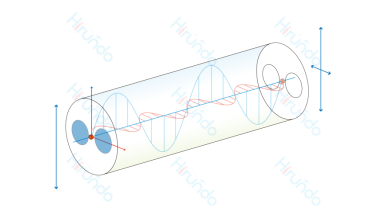
1. Excellent polarization retention ability: It can stably transmit two orthogonal line-polarized light, and its key indicator, polarization extinction ratio (PER), can be better than -20dB, effectively ensuring the integrity of polarization information in sensitive systems.
2. Low insertion loss: The typical insertion loss can be less than 0.1dB, and the additional loss is very small, ensuring that the optical signal still has high strength and high signal-to-noise ratio after distribution.
4. Large core diameter fiber optic coupler: "optical channel" specially built for high-power transmission
When the application scenario shifts from microwatt-level communication signals to kilowatt-level high-power lasers, the fiber core of ordinary optical fibers is difficult to bear. Large diameter fiber couplers are designed for efficient transmission of high-power lasers.
It uses specialty fibers with significantly larger core diameters (e.g., hundreds of microns) and higher numerical apertures. Although its manufacturing process is also based on the principle of melt tapering, it has unique challenges and requirements in process control due to different fiber attributes. Through a special process, a special waveguide structure is formed in the coupling area that can adapt to the transmission of optical signals in the large mode field.
Core Benefits
1. High power carrying: The huge core area allows it to access and transmit higher optical power, effectively avoiding damage to devices due to excessive power density.
2. Excellent beam compatibility: Perfectly matched with large core diameter laser output fibers, high coupling efficiency, can maximize laser power.
3. Stable performance: It has good coupling ratio stability and achromatic performance over a wide wavelength range, making it suitable for a variety of high-power laser beam combining, beam splitting, and sensing applications.
3. Core application scenarios of fiber optic couplers
Fiber-to-the-home (PON network): Enables passive light splitting of one backbone fiber to multiple users, which is a key component of broadband access networks.
Data center optical interconnection: complete the aggregation and distribution of signals between servers and switches to support massive data exchange in cloud computing;
Optical fiber sensing system: used to couple sensing signals and reference light, widely used in security monitoring, infrastructure health diagnosis and other fields;
High-power laser system: Combined beam multi-beam laser to increase output power, used in industrial processing, medical and other fields.
4. Product display and characteristics
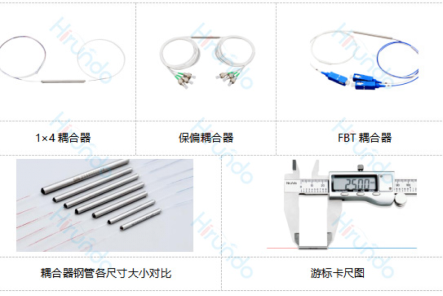
Facing the diversified needs of customers, Hirundo committed to provide comprehensive, reliable and highly customizable coupler product solutions:
✧ Wide wavelength coverage: Supports wavelength range from 400 nm to 2000 nm, covering standard single/dual Windows and special wavelengths (such as 450 nm, 520 nm, 633 nm, 780 nm); Supports small core diameter optical fibers (such as 3 μm) and multiple core diameter options ranging from 100 μm to 600 μm;
✧ Diverse fiber optic options: Compatible with single-mode (such as 9/125 μm), multi-mode (such as 50/125 μm), and polarization-maintaining (PM) fibers, suitable for different application scenarios;
✧ Flexible configuration options available: The splitting ratio can be freely selected from 1/99 to 50/50. Port configurations cover various forms such as 1x2, 2x2, 1x3, 1x4, and 3x3;
✧ Customized design is available: Special wavelengths or spectral ratios can be customized according to requirements. Supports multiple packaging forms, including 3x30 mm, 3x25 mm, 2.4x25 mm, 2.0x15 mm (mini type) and other steel pipe packaging, as well as LGX box, ABS box and 1U rack-mounted packaging solutions;
✧ High reliability: The entire series of products adopts a FBT process, combined with an enhanced packaging design, to ensure low insertion loss, high return loss and excellent environmental stability, meeting the long-term usage requirements under harsh conditions.