
Demystifying MPO Connectors: The "Precision Engine" of High-Density Fiber Optic Networks

Demystifying MPO Connectors: The "Precision Engine" of High-Density Fiber Optic Networks
How to achieve efficient, stable, and high-density optical fiber connections in high-speed optical communication scenarios such as data centers, 5G base stations, and fiber-to-home? MPO connectors are a key technology for this purpose. It is like the "precision engine" in the optical fiber network, with multi-core parallelism, fast plugging and unplugging, and precise docking as its core advantages, promoting optical communication systems to move towards higher capacity and higher density.
1. What is an MPO connector?
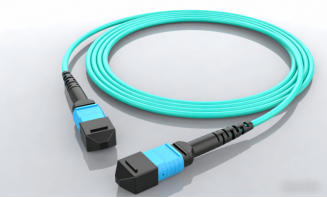
MPO (Multi-fiber Push On) is a high-density fiber optic connector that can realize the one-time docking of multi-core fibers. It is widely used in scenarios such as data center cabling, high-density optical communication equipment interconnection, and fiber-to-the-home (FTTH), which can greatly improve cabling density and O&M efficiency.
2. Core technology analysis: How does MPO achieve precise docking?
Precision ferrule and matrix arrangement
At the heart of MPO connectors are multi-core fiber ferrules, typically made of ceramic materials, with ferrule end faces pre-embedded with varying numbers of fibers such as 8, 12, and 24 cores, arranged in a strict matrix (e.g., 12 pins in 2 rows and 6 columns). The accuracy of the ferrule directly determines the loss level of fiber docking, and the fiber core diameter deviation needs to be controlled at the micron level.
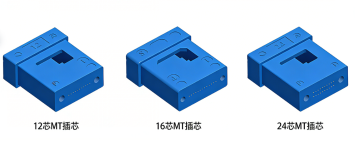
2. Guide needle positioning system
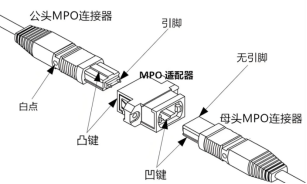
The connector is divided into male and female, with two precision metal guide pins built into the male and a guide hole at the corresponding position of the female head. When the connector is plugged and unplugged, the guide pin is first inserted into the guide hole to force the precise alignment of the male and female ferrules, ensuring that the two ends of the fiber core correspond one by one, and avoiding connection loss caused by misalignment.
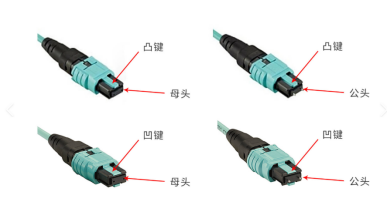
3. Push-pull locking structure
The connector housing features a "push-pull" snap design that allows for coupling by gently pushing in when inserted and unlocking by pressing the clips on both sides when pulled out. This structure not only ensures the stability of the connection, but also enables quick plugging and unplugging, adapting to the frequent maintenance needs of high-density cabling scenarios.
4. Physical contact end face process
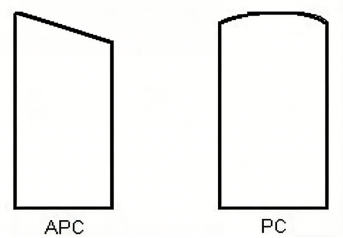
The ferrule end face of MPO connectors is typically physically contacted using a grinding process (such as UPC or APC end face). The UPC end face is designed with a microspherical design, and the APC end face is designed with an 8° oblique spherical design, which is designed to make the fiber core at both ends fit tightly, reduce Fresnel reflection loss caused by air gaps, and ensure that the optical signal is transmitted with low loss in the core.
5. Optical signal transmission path
When the MPO connector is coupled, the optical signal from the transmitting fiber is transmitted directly to the receiving fiber core through the core. Its transmission principle is the same as that of ordinary single-core optical fibers, that is, the refractive index difference between the fiber core and the cladding is used to achieve total reflection transmission of light. The difference is that MPO can complete the parallel transmission of multiple fibers at the same time, greatly increasing the cabling density.
3. Core application scenarios
Data center cabling: suitable for high-density optical fiber interconnection between servers and switches;
Fiber-to-the-home and campus networks: for rapid deployment and connection of backbone fiber optic cables;
Internal interconnection of high-density devices: Compact connections in optical modules and fiber distribution frames;
High-end polarization-sensitive systems: Bias-preserving MPOs can be used in precision fields such as fiber optic sensing, lidar, and quantum communication.
4. Product display and characteristics
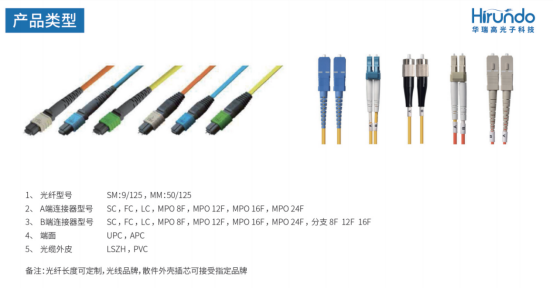
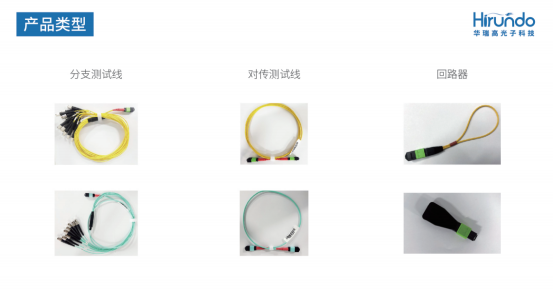
Hirundo offers a full range of MPO connection products, including branch test lines, cross-pass test lines, circuits, etc., with the following outstanding features:
★ End face protection
non-contact docking to avoid end face scratches and protect high-value optical modules.
★ Ultra-long life
The plugging and unmating life is up to 3-5 times that of conventional products, and the MPO multi-core product can reach 300-600 times.
★ High repeatability and interoperability
Supports random plugging and unplugging, stable and reliable performance.
★ Insensitive to dirt
It has strong anti-interference ability to dust and oil.
★ Quick replacement
Push-pull structure design, easy to plug and unplug, improve production efficiency.
★ Fool-proof design
The branch structure simplifies wiring and avoids operational errors.
5. Conclusion
Hirundo MPO connectors provide efficient, stable and convenient connection solutions for high-density optical communication scenarios with precise structural design and strict quality control standards. We always focus on the actual needs of customers, provide customized products with multiple core counts and multiple polarities and full-process technical support, and strive to ensure that each product fits the wiring scenario and can withstand practical testing. If you need to customize the product solution or learn more details, please feel free to contact us. Hirundo, join hands with you to create a high-speed interconnection future in the optical communication industry!