
A Single Letter Difference | Understand the Underlying Logic of MPO and MTP

Optical Communication:
Introduction to MPO/MTP Connectors
Author: Virgil
What Is MPO and MTP?
MPO is the abbreviation for Multi-fiber Pull Off. The ferrule of this connector contains multiple optical fibers and is locked in place via mechanical clamping structure.
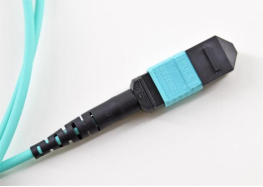
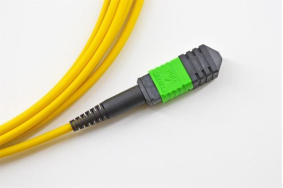
Various MPO designs are available from different manufacturers on the market. Connector products of different models differ greatly in performance and cost. Some products deliver outstanding performance, while the compatibility of MPO connectors with products from other brands varies widely. Such interoperability depends on how closely the connector design complies with official standards. The complete specifications of MPO connectors are defined in IEC-61754-7 and EIA/TIA-604-5 (also known as FOCIS 5).
What Is the Difference Between MPO and MTP?
MPO (Multi-fiber Pull Off) refers to the first-generation spring-clamped multi-fiber optical connector designed by NTT Communications Corporation of Japan, which is now a general designation for multi-fiber connectors manufactured by multiple enterprises. MTP is a registered trademark of US Conec, exclusively referring to its self-produced MPO-style connectors. Simply put, MTP specifically stands for connectors made by US Conec, while MPO refers to multi-fiber connectors from all other brands.
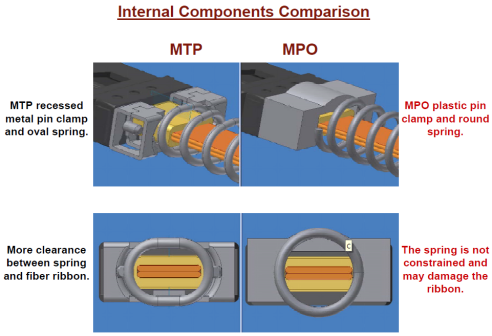
The MTP connector is a high-performance MPO connector with multiple innovative designs. Compared with ordinary MPO connectors, MTP fiber connectors feature optimized optical and mechanical performance. MTP connectors fully comply with all professional standards for MPO connectors, including EIA/TIA-604-5 FOCIS 5 and IEC-61754-7.
Features of MTP/MPO Connectors
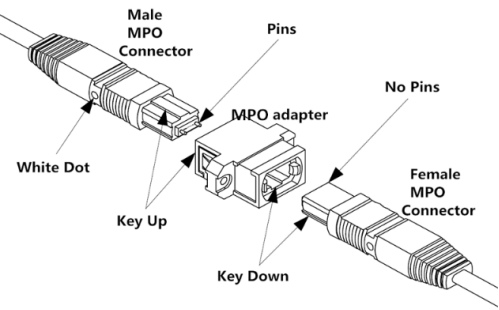
1.Classification of Male and Female Connectors: male connectors are equipped with alignment pins, while female connectors have no alignment pins.
2.Polishing type: APC is generally adopted for single-mode fibers, and PC for multimode fibers.
3.Two insertion loss (IL) specifications: low insertion loss products with insertion
loss≤0.35 dB for single-mode fibers and ≤0.30 dB for multimode fibers; standard insertion loss products with SM IL <0.7 dB and MM IL <0.5 dB.
4.The mainstream ferrule core counts applied in data centers are 12-core, 16-core and 24-core.
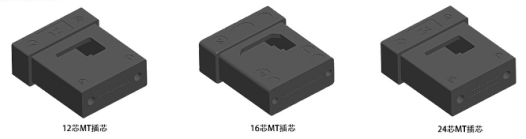
Common 12/16/24-Core Ferrules
5.MPO Component Kit
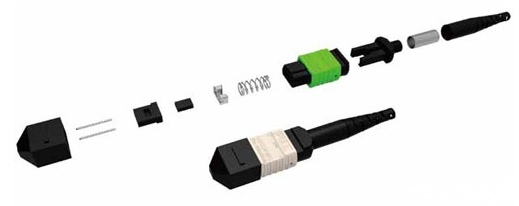

MPO Component Kit
MTP/MPO Polarity Standards
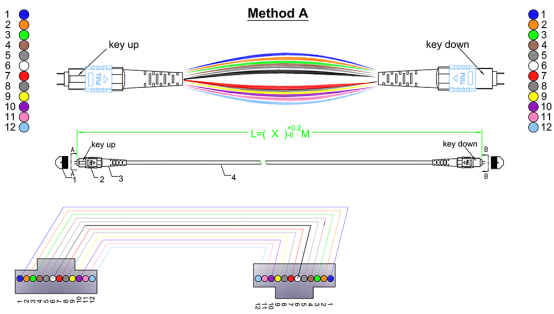
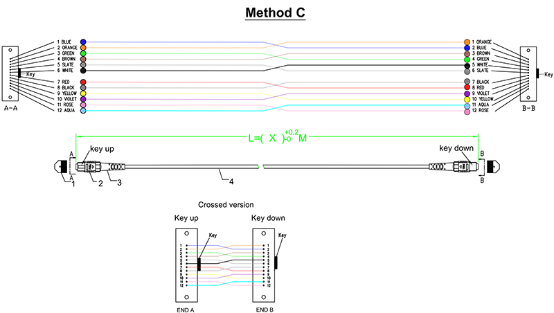
The TIA568 standard defines three polarity wiring methods, namely Method A, Method B and Method C. To comply with TIA568 requirements, MPO trunk cables are divided into three types: straight-through, fully cross-connected and pair-cross connected, i.e. Type A (Key-Up to Key-Down: Straight-through), Type B (Key-Up to Key-Up / Key-Down to Key-Down: Fully cross-connected), Type C (Key-Up to Key-Down: Pair-cross connected).
1.Straight-Through MPO Trunk Cable
Straight-through MPO trunk cables adopt straight fiber routing, pre-terminated with a Key-Up MPO connector at one end and a Key-Down MPO connector at the other end. Thus the fiber position mapping at both cable ends is consistent, meaning the No.1 fiber hole of the connector on the left corresponds to the No.1 fiber hole of the connector on the right. The figure below shows the fiber sequence of straight-through MPO trunk cables:
2.Fully Cross-Connected MPO Trunk Cable
Fully cross-connected MPO trunk cables adopt reversed fiber routing, with Key-Up MPO connectors pre-terminated at both ends. The fiber position mapping at two ends of the cable is completely reversed, meaning the No.1 fiber hole of the left connector corresponds to the No.12 fiber hole of the right connector. The figure below shows the fiber sequence of fully cross-connected MPO trunk cables:
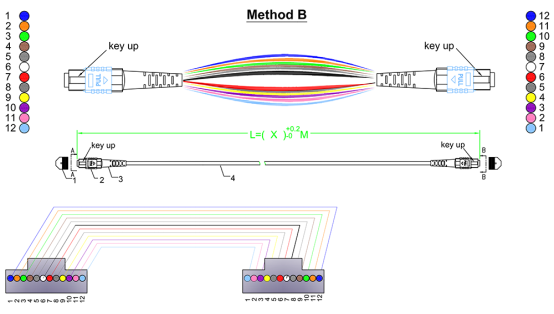
3.Pair-Cross Connected MPO Trunk Cable
Same as straight-through MPO trunk cables, pair-cross connected MPO trunk cables are pre-terminated with a Key-Up MPO connector at one end and a Key-Down MPO connector at the other end. However, the positions of two adjacent fibers at one cable end are reversed relative to those at the other end, meaning the No.1 fiber hole of the left connector corresponds to the No.2 fiber hole of the right connector, and the No.2 fiber hole of the left connector corresponds to the No.1 fiber hole of the right connector. The figure below shows the fiber sequence of pair-cross connected MPO trunk cables:
Applications of MPO/MTP Connectors
Both enterprise local area networks and data center backbone networks are evolving toward high-density cabling to meet growing bandwidth supply and high-density interconnection demands. MPO/MTP multi-fiber cables are developed to satisfy high-density cabling requirements. Especially during the network migration from 10G to 40G/100G, MPO/MTP trunk cables have become the preferred solution for most network engineers.
Ultra-High-Density MTP®/MPO Fiber Distribution System
With fiber optic systems evolving from single-mode to multimode transmission and network speeds upgrading from 10G to 40G and 100G, stricter performance requirements are imposed on fiber connectors. 40G and 100G Ethernet transmission have become mainstream trends for data center cabling systems. Traditional connectors can hardly meet the higher density and performance requirements of modern data centers. In accordance with international standards, high-density MTP®/MPO connectors have become the standard interface for 40G and 100G Ethernet transmission. MTP®/MPO is a standardized compact high-density fiber connector compatible with ribbon and bundled optical cables, delivering stable and reliable connections. MTP®/MPO patch cords using ribbon or bundled fibers are pre-terminated and fully tested in factories, enabling fast on-site equipment connection with plug-and-play function to accelerate data center deployment. The MTP®/MPO cabling system serves as an ideal solution to the surging high-capacity distribution demands of data centers, featuring simple installation, convenient and efficient construction, no special tools required, compact structure, high manufacturing precision and plug-and-play capability.
Conclusion
Hirundo supplies MPO/MTP fiber connectors and patch cords of all specifications. As a high-tech enterprise integrating R&D, manufacturing, sales and after-sales service of passive optical communication basic components, Hirundo specializes in passive optical devices, which are widely applied in FTTx, 4G/5G communication networks, internet data centers, national defense communications and other fields.
(This article and attached images are for learning reference only. Please contact the website for removal if any copyright infringement or other issues occur.)