From Communication trunk lines to sensory nerves: Key Applications and Frontier Breakthroughs of Optical Circulators

From Communication trunk lines to sensory nerves: Key Applications and Frontier Breakthroughs of Optical Circulators
Optical ring keywords
The optical ring is a non-reciprocal, multi-port optical passive device. Its core function is that optical signals can only be transmitted in one direction from the port to the terminal in a specific order.
Typical Construction: The most common is the three-port annular (Port 1→ Port 2 → Port 3).
Core feature: non-reciprocity. This means that the direction of light transmission is fixed, and the loss of reverse transmission is extremely high (i.e., highly isolated).
Analogy: Similar to a "diode" in an electronic circuit, but with three or more "pins" that allow signals to travel along a circular path.
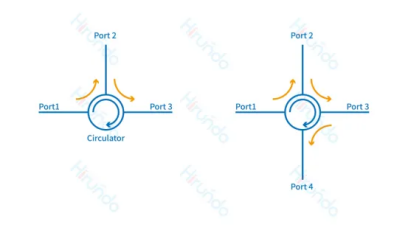
When the optical signal is input from a specified port, it can only travel in the specified order (A→B→C→D→A) in the device. When the transmission order of optical signals changes (such as B→A or D→B, etc.), the loss is large, which can achieve signal isolation.
Since this sequential propagation is not required in most applications to form a closed loop, that is, there is no need to make D finally communicate with A, such a ring is called a quasi-optical looper, and most of the commonly referred to as a quasi-optical ring is also this kind of quasi-optical loop. This non-reciprocal property of optical annulators is similar to that of optical isolators, and is mainly achieved by using the Faraday effect of magneto-optical materials.
Part.1 Working principle
It works based on two main physical effects:
Faraday Effect (Core)
This is the magneto-optical effect, which is the source of the non-reciprocity of the annulus.
When linearly polarized light passes through Faraday polarized materials such as yttrium garnet crystals in an applied magnetic field, its polarization plane rotates.
Key point: The rotation angle is related to the direction of the magnetic field, not the direction of light propagation. This is the physical basis for achieving one-way transmission.
Birefringent crystals/filter
It is used to control and manage the polarization state of the beam, and cooperates with Faraday polarizers to realize the spatial separation and routing of optical paths.
Part.2 Application of optical ring
Due to this sequential transmission characteristic of the optical annulus
It can be used to separate forward and reverse transmission optical signals in the same fiber. When used in fiber optic communications, fiber sensing and fiber optic test systems, the system structure is often simplified.
Here are some typical applications of it in optical communication systems:
Combined with Fiber Bragg Grating (FBG) applications
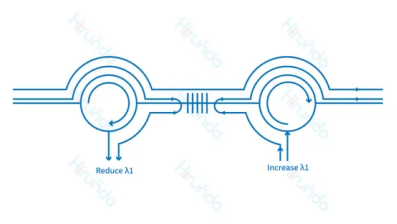
Figure 1
Figure 1 is an up/down multiplexer (OADM) consisting of a ring and a fiber grating. Similar applications include demultiplexing and dispersion compensators made of chirping fiber gratings.
Combined application with fiber optic amplifiers

Figure 2
The EDFA is coupled with a ring device, so that the optical signal is amplified through the EDFA, and then reflected by the high reflection film at its output end, and then passed through the gain medium in the opposite direction. This is equivalent to doubling the length of the gain media, which greatly improves the pumping efficiency of the EDFA and reduces the pumping energy required.
Applications in fiber optic transmission systems
Applying an optical ring to an optical transceiver module enables bidirectional transmission of the same wavelength in a single fiber.

Figure 3
Figure 3 shows a single-wavelength bidirectional synchronous communication system, in which the optical ring connecting the transceiver to the transmitting optical fiber separates the output and received optical signals, achieving full-duplex transmission with only one channel.
Application in OTDR
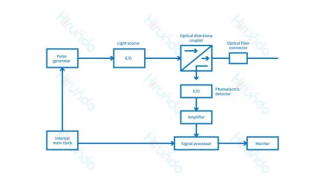
In addition, the optical ring can also be used as a coupler in optical time-domain reflectometers (OTDRs) and fiber optic gyroscopes (Sagnac interferometers), which improve system performance well.
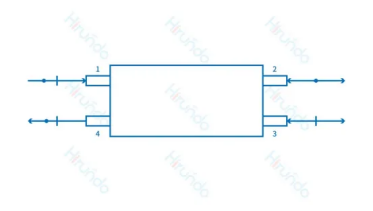
Integrated devices composed of other passive devices
In a device that integrates the functions of a circular and a polarized optical beam splitter (PBS), the beam incident from port 1 will be decomposed into line-polarized light perpendicular to each other in two polarized states, which will be emitted from port 2 and port 3 respectively.
The two beams of line-polarized light incident from port 2 and port 3 with the same polarization direction will be combined into one beam from port 4.
In fact, this device functions as a combination of a pair of PBS and polarizing combiners (PBCs).
Part3 The circulators that Hirundo can provide
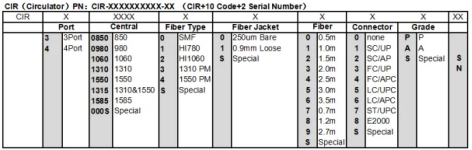
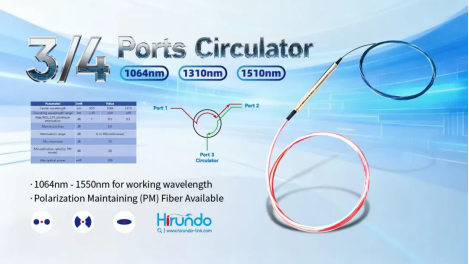
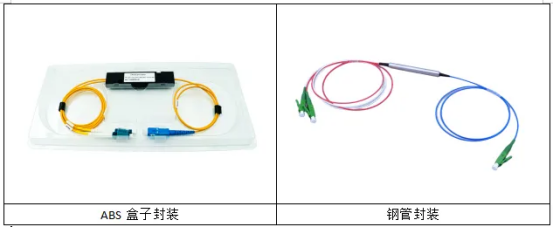
Hirundo is a professional micro-light source device manufacturer, which can provide customized three-port, four-port, different power, and wavelength optical fiber circulators, and support the production of bias-preserving annulators. The production process is mature, with perfect production and testing automation equipment, which can provide customers with high-quality optical device products.