
AWG : An Innovator In The Field Of Optical Communications

AWG: An Innovator In The Field Of Optical Communications
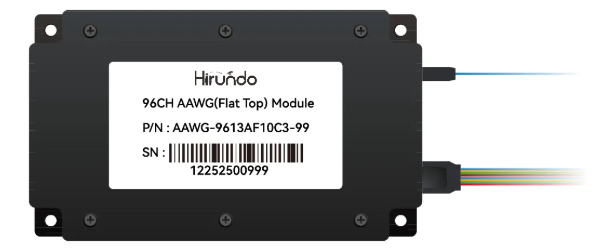
AWG is typically used in optical (de)multiplexers in wavelength division multiplexing (WDM) systems. It can combine multiple wavelengths of light into a single optical fiber, enhancing the propagation efficiency of optical fiber networks.
The structure of AWG
Input waveguide
This is the entry point of the optical signal, responsible for introducing the DWDM signal into the AWG.
Input star coupler
Located after the input waveguide, its function is to evenly distribute the optical signal to each array waveguide. This process is wavelength-independent; that is, all wavelengths are indiscriminately assigned to the array waveguide.
Array waveguide
This is a group of waveguides whose lengths are arranged in an arithmetic series. For instance, the length of the first waveguide is L₀, and the length Li of the i-th waveguide is a term of some arithmetic sequence. These waveguides generate phase differences for multiple beams, and the phases of each beam also form an arithmetic series.
Output star coupler
Located behind the array waveguide, its function is to focus the optical signal processed by the array waveguide onto different output waveguides. Due to the phase difference generated by the array waveguide, optical signals of different wavelengths will be focused to different positions in the output star coupler and then received by different output waveguides.
Output waveguide
Responsible for exporting the demultiplexed optical signal from the AWG; each output waveguide corresponds to a specific wavelength.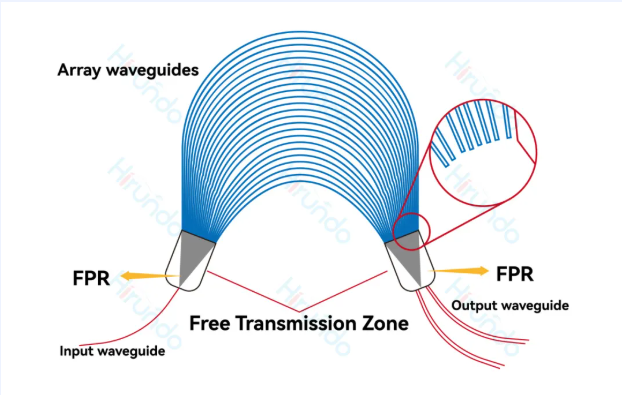
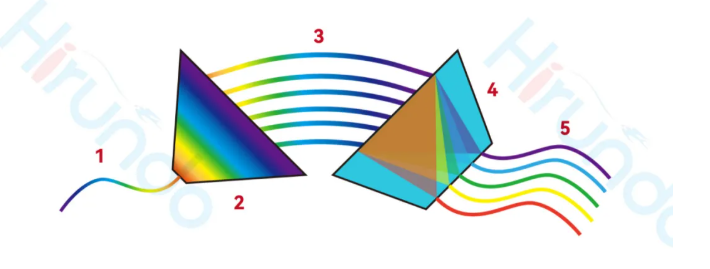
The DWDM signal enters the input star coupler from the input waveguide and, after free transmission, is distributed into the array waveguide. This distribution process is wavelength-independent, and all wavelengths are indiscriminately distributed into the array waveguide. Array waveguides generate phase differences for multiple beams, and the phases of each beam are in an arithmetic series, which is similar to the situation in traditional gratings. Different wavelengths are dispersed and expanded and focused at different positions in the output star coupler. Different wavelengths are received by different waveguides, thereby achieving parallel demultiplexing of DWDM signals.
2. Classification of AAWG
Compared with other wavelength division products (technologies such as FBG and TTF),
AWG has the advantages of high integration, a large number of channels, small insertion loss and ease of batch automated production.
AWG chip cutting (laser cutting)
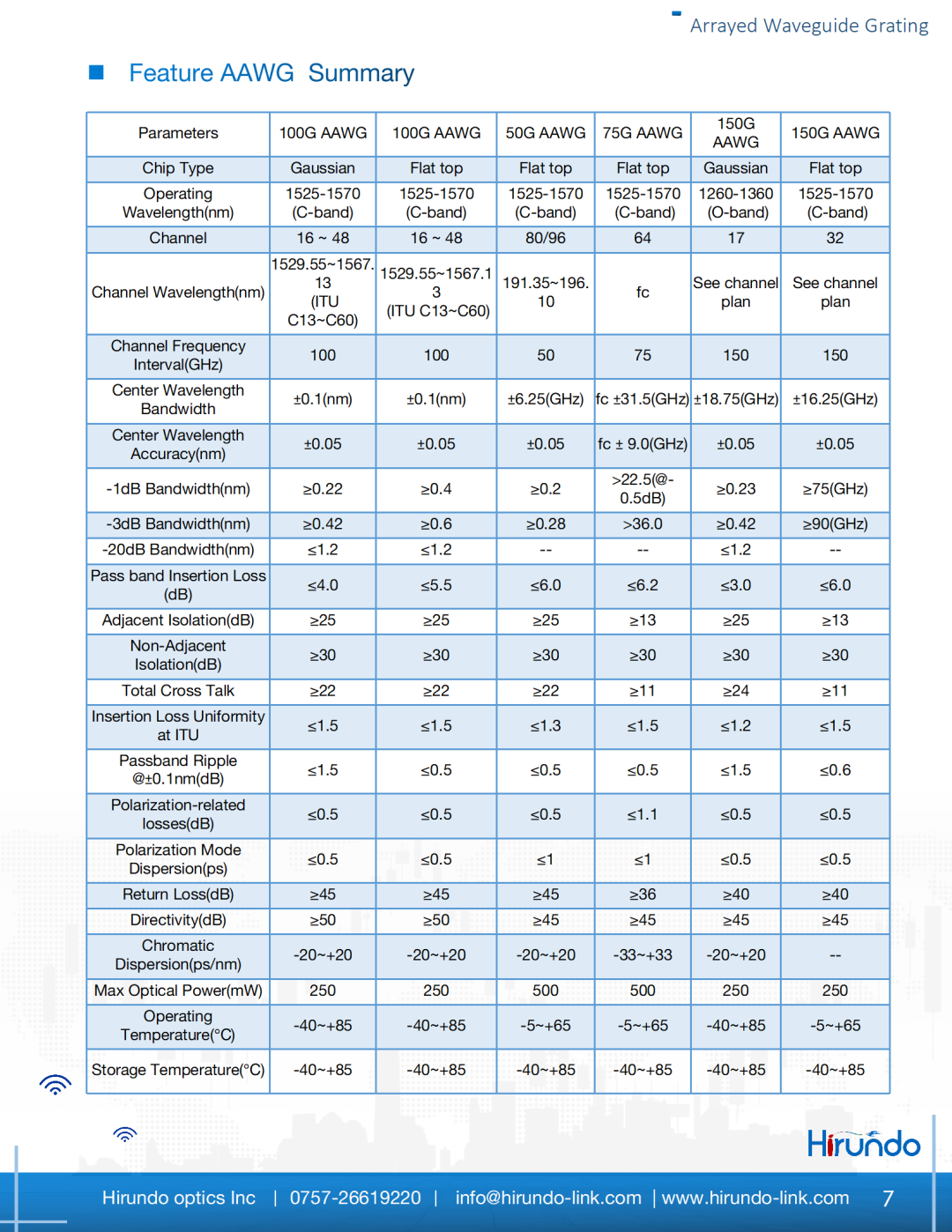
Hirundo uses laser cutting technology to process AWG raw materials, which has the advantages of high efficiency, high precision, and high quality. Hirundo can also provide different types of AAWG to meet customer needs, as follows:
Application Reuse and demultiplexing
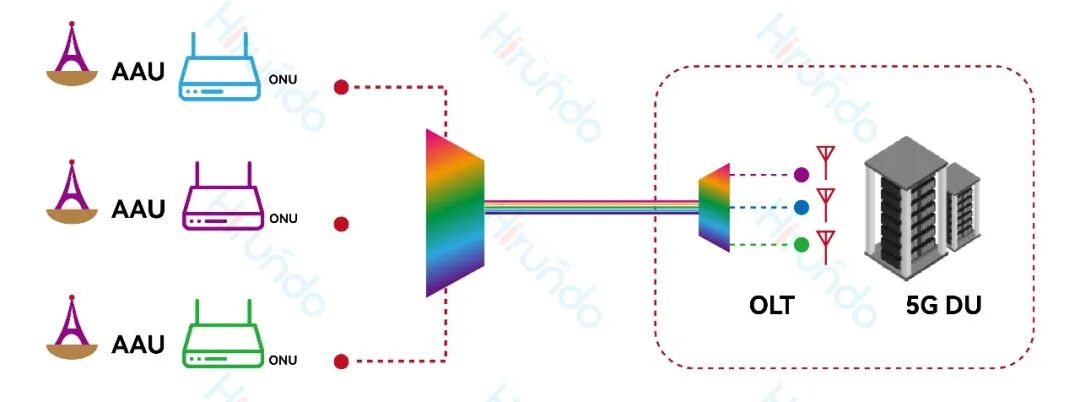
In dense wavelength division multiplexing (DWDM) systems, AWG is used as a multiplexer and demultiplexer. At the input end, AWG can combine light of different wavelengths into a single optical fiber to achieve multiplexing. At the output end, AWG separates light of different wavelengths into different output ports to achieve demultiplexing. For instance, in a multiplexer, the primary function of AWG is to separate or combine components of different wavelengths, thereby effectively enhancing the efficiency of network transmission.
2. Spectral analysis
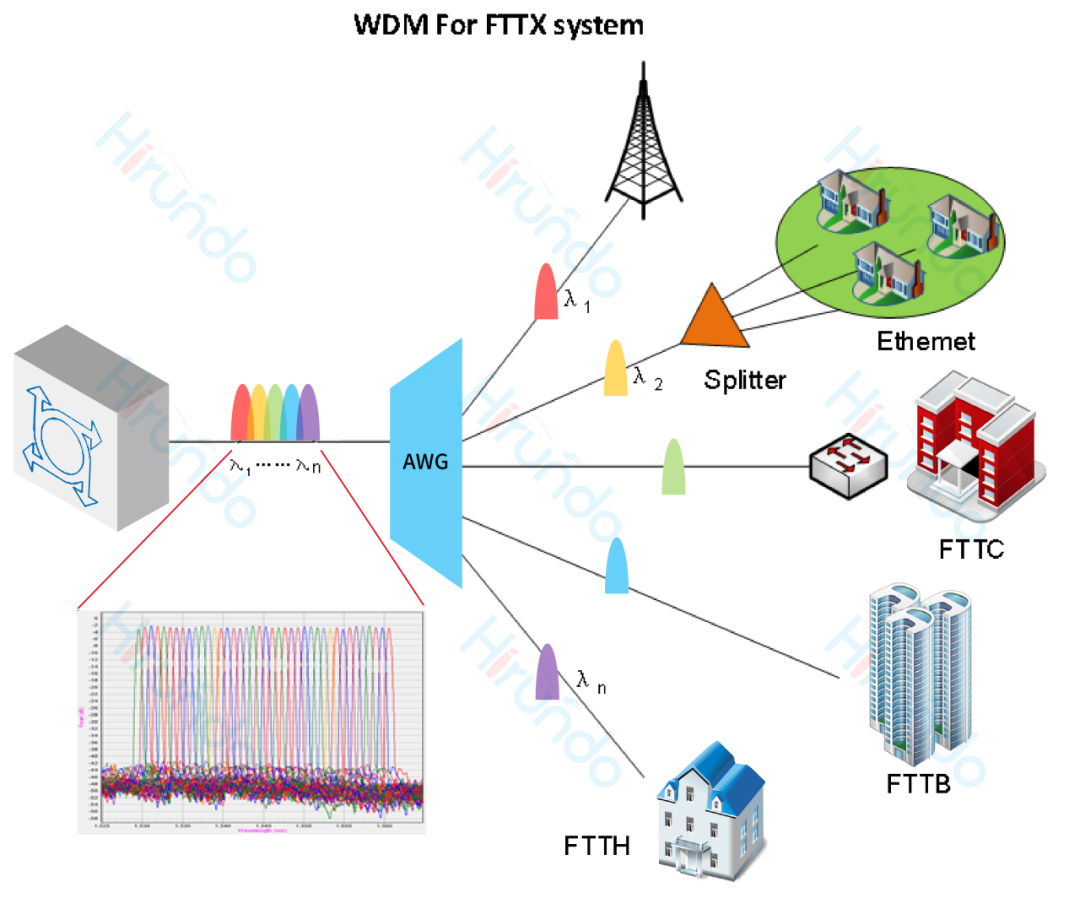
AWG is based on the principles of waveguide phase modulation and grating refraction. By rationally designing the length of the optical waveguide and the distance between waveguides, it enables optical signals of different wavelengths to interfere on the output waveguide, thereby achieving wavelength separation and spectral splitting. This characteristic enables AWG to decompose a light signal containing multiple wavelengths into its constituent wavelengths, thereby achieving detailed analysis of the spectrum.
3. Field of photonic integrated circuits
The multi-channel number feature of AAWG is widely applied in long-distance signal transmission in metropolitan area networks, backbone networks, data centers, etc. Its excellent PMD characteristics (<0.5 ps) can better meet the requirements of 40G/100G DWDM transmission systems and satisfy the PMD tolerance of high-speed systems.
Characteristics of AWG
✔ Stable performance
The AWG arrayed waveguide grating features high performance stability. Its waveguide structure and optical design can ensure the stability and performance of the device during long-term operation. This stability is crucial for the continuous and stable operation of optical communication systems.
✔ Low insertion loss
The waveguide design and manufacturing process of AWG can achieve low insertion loss, enhancing the transmission efficiency of optical signals and system performance. In optical communication systems, reducing insertion loss is crucial for transmission distance and signal quality.
✔ Strong flexibility
AWG has a high degree of flexibility and can design and customize device parameters according to specific application requirements. This flexibility enables AWG to be suitable for different scenarios and application requirements and can provide customized wavelength processing and management functions for the system.