
CEx WDM Module Application | OFC Show Preview - Booth: 4617

CEx WDM Module Application | OFC Show Preview - Booth: 4617
CEx WDM module applications
Through WDM technology, the smooth evolution and comprehensive upgrade of G/EPON to NG-PON1 system (10GEPON, XGPON, XGS-PON) to NG-PON2 system (OFDM-PON, DWDM-PON, TWDM-PON) have been in place as early as EPON when it first came out. 12 years is the big boom in EPON construction, 14 years is GPON, and 16/17 GPON construction is still continuing, I believe that the day of doing 10GPON is not far away. But to abandon the original system, this cost is too great.
Now you can plug in WDM to achieve coexistence and smooth upgrades.
G/EPON and NG-PON1 systems
For the wavelength selection of NG-PON1 system, XGS-PON: uplink: 1270nm, downlink: 1577nm.
The standard of NG-PON1 system has been out for many years, and products and equipment have gradually entered the market. This makes more people think about how to coexist. At the same time, in the integration of radio and television networks and G/EPON broadband networks, ODN networks actually need 'three-network integration': G/EPON, NG-PON1, and CATV.
GPON is a broadband passive optical network access technology that complies with the ITU-T G.984.x standard. With its many advantages such as high bandwidth, high efficiency, unified support for multiple services, good interoperability and manageability, it is being favored by more and more mainstream operators and is regarded as an ideal solution for FTTx (especially FTTH). However, with the vigorous development of PON network large-scale applications and the rapid development of full-service operations, while protecting existing investments, people have gradually put forward higher expectations for PON systems in terms of bandwidth requirements, service support capabilities, access node equipment and supporting equipment performance.
As a result, how GPON evolves into the next generation of systems has attracted much attention from the industry. With the active participation, joint efforts, and active contributions of major carriers around the world and major equipment manufacturers including Huawei, FSAN/ITU-T completed the work on NG PON standards in June 2010. Under the expectations of the industry, the 10GPON system, which can be smoothly evolved from GPON, has finally been unveiled and officially entered people's sight.
As mentioned earlier, considering the adequate protection of the operator's deployed fiber optic system, the ODN of 10GPON must fully follow the network topology of GPON and reuse the fibers and splitters that have been deployed in the existing GPON network: first ensure the coexistence with GPON, and further complete the smooth evolution from GPON to 10GPON by adding interface boards that support 10G on the OLT side and replacing ONT/ONU. In order to achieve coexistence with GPON on the same ODN, 10GPON adopts up/down wavelength planning, which is different from GPON, so as to place WDM1r devices at the local end, combined with the WBF devices in the front or embedded terminals, to combine multiple working signals in the up/down direction to achieve compatibility between 10GPON and GPON.
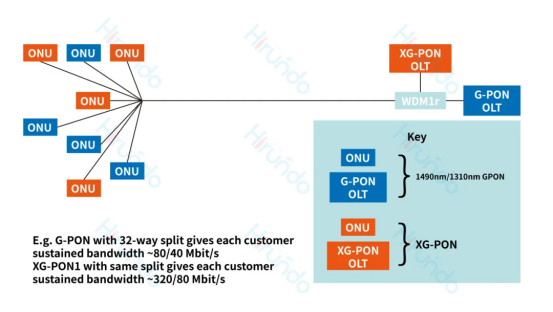
On the basis of coexistence, 10GPON further provides a smooth evolution implementation: when upgrading, operators can choose to upgrade only a subset of user devices on this ODN in batches or replace all user devices with next-generation devices at once. The difference between the two upgrade methods is the length of time that GPON and 10GPON systems have existed together. To upgrade from GPON to 10GPON, all ONUs and OLTs must strictly follow the wavelength plan specified in ITU-T G.984.5amd1 (Extended Band).
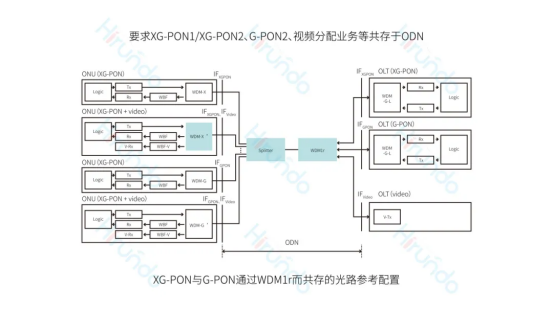
Current GPON and EPON systems use the same wavelength scheme, i.e., 1310nm upstream, 1490nm downstream, and 1555nm video overlay. In the recently released NG-PON1 system (including 10G GPON and 10G EPON, hereinafter referred to as 10G PON) standards, the uplink and downlink wavelengths of 1270nm and 1577nm are selected respectively, and the reason is that these two wavelengths can easily realize the WDM coexistence scheme. In this scheme, the passive optical splitter can reuse existing and new systems, and the occlusion filter of the ONU can effectively prevent interference. At the same time, some nonlinear optical effects (mainly Raman crosstalk) are also considered, which are controllable for NG-PON systems.
WDM1r devices, also known as Combo WDM and XGPON wavelength divisions.
G/EPON and NG-PON1, NG-PON2 systems
NG-PON2 has a variety of options, among which the more popular ones are TWDM, OFDM, and DWDM. For TWDM wavelength selection, NG-PON2: uplink: 1530nm, downlink: 1600nm.
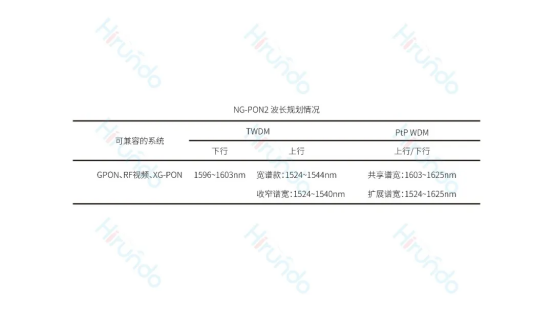
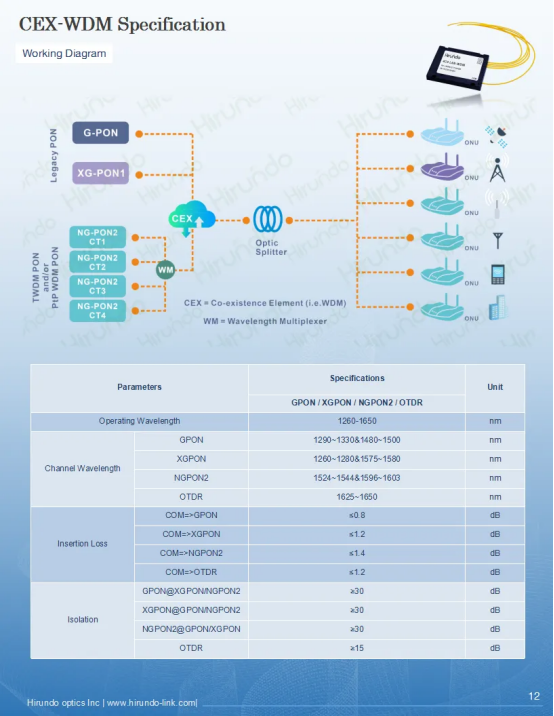
In order to share G/EPON with NG-PON1 and NG-PON2 systems, it is necessary to use CEx wavelength coexistence original, also known as Coexistence WDM (coexistence wavelength division), which should be selected according to the actual situation, and of course, Co-WDM can also be used instead of WDM1r.
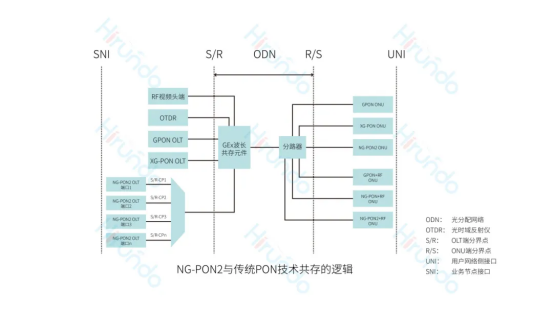
PON system and OTDR detection
For OTDR wavelength range: 1625-1650nm
Advantages of PON Networks
Low relative cost, simple maintenance, easy expansion, easy upgrade.
PON structures do not require power supply and no electronic components during transmission, so they are easy to lay and basically do not need maintenance, and the long-term operating costs and management costs are greatly saved. With the rapid development of EPON and GPON technologies, OTDR is an essential tool in the initial installation, acceptance and later maintenance stages of network construction.
In the process of PON network construction, sufficient testing in the line construction stage can detect excessive bending of optical cables and joint failures caused by improper laying at an early stage, which will minimize the network maintenance workload in the later operation stage.
During the line rectification process, OTDR can be used to check for faults, poor cable stranding, fiber breaks, or large bends in order to accurately locate fault points.
Acceptance of PON networks Testing the availability of fiber optic lines. In the FTTH line, the PON device belongs to the access layer device, and the ordinary user is very closely connected, and generally the fault will lead to the interruption of the user's business, so the maintenance personnel must quickly judge the nature and location of the fault in order to repair the fault. In fault handling, the first step is to accurately locate the fault point, if it is a fiber optic line fault, using OTDR for testing can help quickly locate the fault point, OTDR for PON maintenance is a very important tool.
However, the maintenance of PON networks is different from that of ordinary fiber optic networks. When the general optical fiber line is maintained, it is usually a service interruption test, but in the PON network, it is generally carried out in the form of online testing, because PON adopts the backbone fiber sharing method, and when troubleshooting a PON user, it cannot cause interference to other normal user services under the same OLT. This requires that the OTDR can not only work normally under online conditions, but also the test signal of the OTDR cannot affect the working signal of the PON network, so the online test cannot use the wavelength of 1310/1490/1550 for testing.
At present, there are two wavelengths of online monitoring in the world, 1625nm and 1650nm, and ITU-TL.41 recommends using the 1650nm wavelength as the out-of-band test wavelength of OTDR for online testing. At present, both 1625nm and 1650nm wavelengths are supported by mainstream OTDR manufacturers. Using the wavelength of 1625nm for online testing is easy to interfere with communication signals, and the wavelength of 1650nm is more suitable.
Coexistence WDM (Coexistence WDM) parameter
Applications
Ø G/EPON system
Ø WDM PON network
Ø mix PON network
Ø Hybrid PON network
Ø NG-PON/XGS-PON network
Ø NG-PON/XGS-PON network
Bandwidth
G/EPON: Uplink: 1310nm, Downlink: 1490nm
XGS-PON: Uplink: 1270nm, Downlink: 1577nm
NG-PON2: Upstream: 1530nm, Downlink: 1600nm
OTDR: 1625-1650nm
All in all, the current GPON/EPON network can basically meet the bandwidth and service development needs within 10 years. From the perspective of investment protection, there are many possibilities for the evolution of PON networks, whether it is GPON/EPON evolution to 10G-PON, to NG-PON2, or directly across 10G-PON to NG-PON2, the coexistence of existing PON networks is the key to future evolution. At present, all sectors of the industrial chain have begun to research NG-PON2 technology.
About Hirundo WDM products
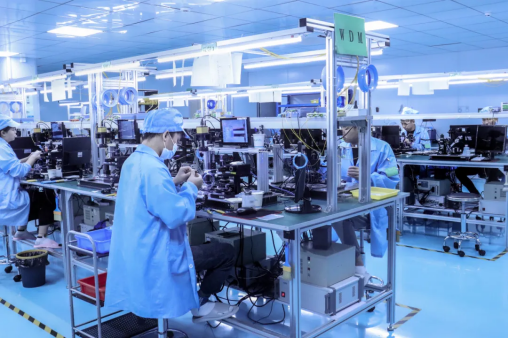
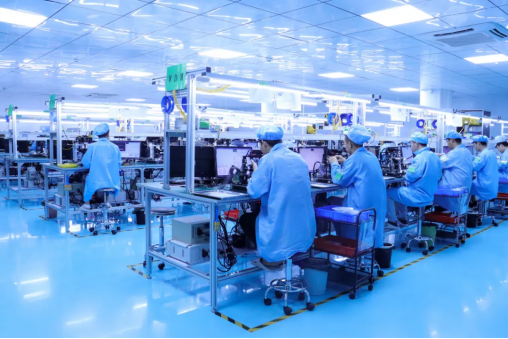
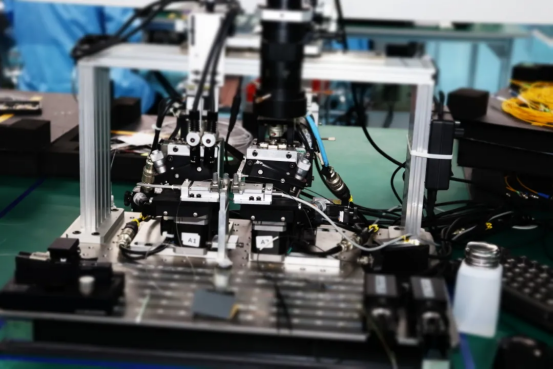
Hirundo is deeply involved in the field of optical communication passive devices, providing global customers with complete solutions from design, integration to batch delivery with one-stop customized services and full-specification WDM products, helping efficient expansion and stable deployment of data centers, 5G communications, optical fiber transmission and other scenarios.
In the field of core xWDM WDM multiplexing devices, Hirundo has the ability to cover all categories, specifications, and scenarios:
Complete categories: It can stably provide CWDM/DWDM coarse/dense wavelength divisions, FWDM filter chip wavelength divisions, Skip Filter bypass filters, CEXWDM, LWDM, CCWDM/CDWDM and other full series of products, supporting any customized wavelength.
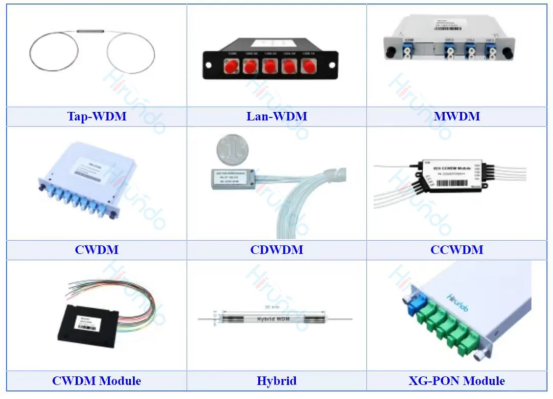
Channel spacing: Accurately cover mainstream channel spacing such as 50GHz, 100GHz, and 200GHz to meet different transmission distance and capacity requirements.
Flexible packaging: Compatible with ABS cassette, metal steel tube, LGX insert, 19-inch rack and other packaging forms, suitable for various installation scenarios such as cabinet integration, equipment embedding, and outdoor deployment.
With mature technology, stable production capacity and personalized customization capabilities, Hirundo provides customers with cost-effective and high-reliability WDM solutions, and has become a reliable partner for optical communication network transmission.
OFC Exhibition Preview
At the OFC exhibition in March, Hirundo invites you to come and find out on the spot!!
Exhibition time: March 17-19, 2026
Exhibition location: Los Angeles Convention Center, USA
Booth No.: No.4617