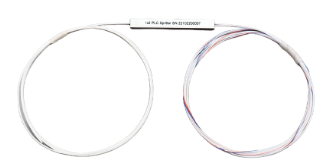
Polarization-maintaining fiber optic passive components

Polarization-maintaining fiber optic passive components
Common polarization-maintaining products include:
polarizer, polarization beam combiner (PBC), polarization beam splitter (PBS), PM connector (PM fiber jumper), PM FBT coupler,
PM PLC splitter , PM isolators, PM circulators, PM optical switches, etc.
Hirundo provides a variety of PM products.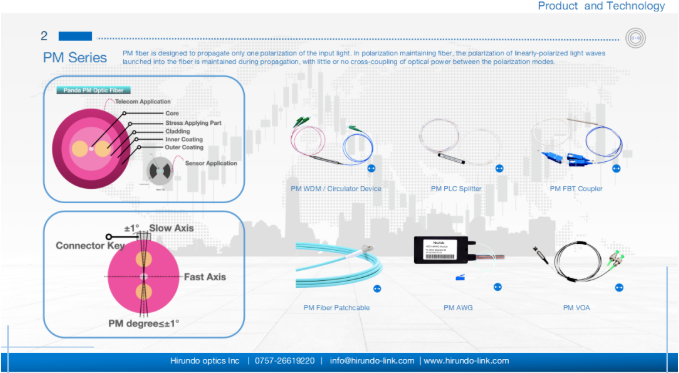
How Polarization-Maintaining (PM) Fiber Works
Even if the optical fiber has a circularly symmetric structure, there is still a certain degree of birefringence effect.
because in practical applications, it is always subject to some mechanical stress or other effects that will destroy the symmetry.
As a result, the polarization state of light as it propagates in the fiber undergoes uncontrolled changes (wavelength-dependent) and is also dependent on fiber bending and temperature.
PM fibers are special optical fibers with strong birefringence that can maintain the polarization state of an incident beam that is linearly polarized in a certain direction.
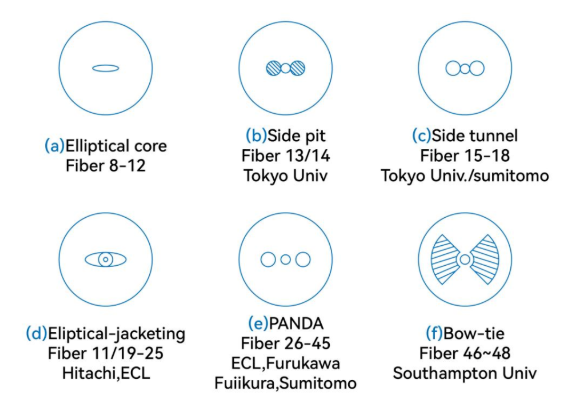
In actual optical transmission, the external stress experienced by the optical fiber constantly changes with changes in the environment and temperature.
Therefore, the polarization mode of light in ordinary optical fibers is unstable.
However, if a high birefringence effect is introduced inside the optical fiber to resist the interference of external stress changes,
The polarization mode of the light transmitted in the optical fiber can be maintained.
Polarization-maintaining fiber is based on this principle to maintain the stable transmission state of polarized light.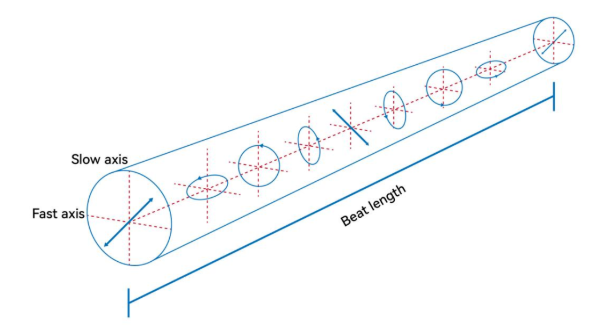
Applications of Polarization Maintaining Fiber
Polarization-maintaining optical fiber transmission lines for polarized light are widely used in various fields of the national economy
such as aerospace, aviation, navigation, industrial manufacturing technology, and communications.
In interferometric optical fiber sensors based on optical coherent detection,
the use of polarization-maintaining optical fibers can ensure that the linear polarization direction remains unchanged
and improve the coherent signal-to-noise ratio to achieve high-precision measurement of physical quantities.
As a special optical fiber, polarization-maintaining fiber is mainly used in sensors such as fiber optic gyroscopes and fiber optic hydrophones.
and fiber optic communication systems such as DWDM and EDFA.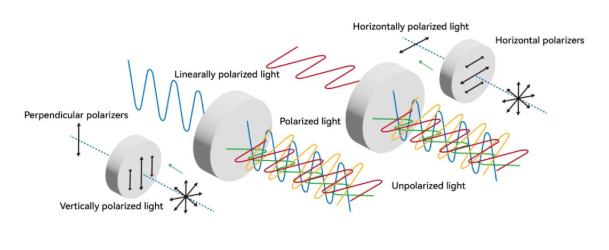
Characteristics of polarization-maintaining optical fiber passive components
Generally speaking, how well the polarization-maintaining fiber maintains the polarization state depends on the incident state of the polarized light.
which requires the polarization state of the polarized light to be aligned with the slow (fast) axis direction of the polarization-maintaining fiber.
Assuming that a beam of ideal linearly polarized light is incident on a polarization-maintaining fiber and the alignment angle error is θ,
Then the possible maximum value of the extinction ratio at the output end is

From this formula, it can be concluded that the output extinction ratio must be greater than 20 dB.
and the angle error must be less than ±3 degrees.
If the extinction ratio reaches 30 dB, the angle error must be less than ±0.9 degrees.
In fact, the polarized light output by the light source cannot be ideal.
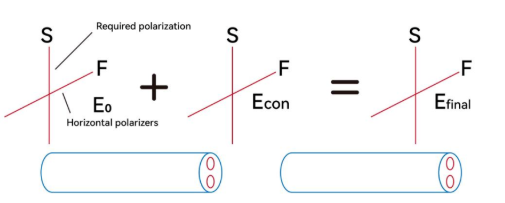
but has an initial extinction ratio ER0.
We can regard the unwanted light as background light signals, and these background light signals accumulate at every connection of the system. Stand up.
If we can ensure that the optical signals of these unwanted polarization states are much smaller than the actual optical signals, we can calculate the final output extinction ratio after each connection.
ERfinal can be obtained by the following formula: 
The purpose of the polarization-maintaining device is to try to maintain the original polarization state of the polarized light or to perform some transformation of the polarization state
when connecting or coupling the polarized light in two polarization-maintaining fibers.
As can be seen from the above introduction, any slight rotation of the connector can lead to a rapid decline in device indicators.
To ensure that the polarization mode transmitted in the optical fiber still maintains a high extinction ratio after passing through the connector,
the alignment of the slow axis or fast axis of the two fibers being connected is key.
The alignment of the modes of the two spliced optical fibers is achieved through the following two conditions.
1) Tolerance and coaxiality of the keyways at both ends of the connector flange.
2) The coupling consistency between the connector key and the polarization direction (fast axis or slow axis) in the optical fiber.
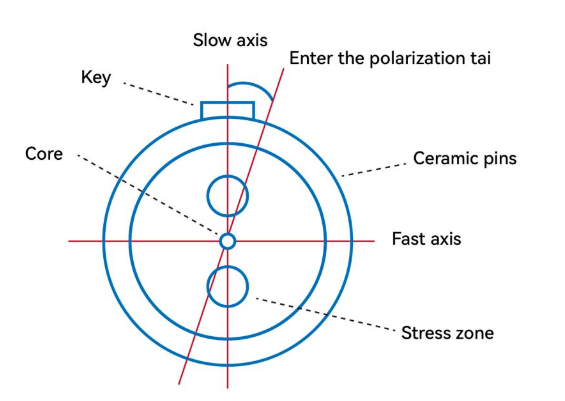
Therefore, each polarization-maintaining connector manufacturer has adopted its own unique approach to reducing the theta angle.
At present, manufacturers that use optical indicators to control the θ angle have begun to appear at home and abroad.
This method truly achieves dynamic control of the final indicator (extinction ratio) rather than indirect control through the θ angle.
It has high specifications, good accuracy, and good interactive exchange ability.
Hirundo Optics is a professional manufacturer of optical communication equipment.
Hirundo can provide a full range of technically optimized product solutions for PM products.
supporting a variety of specifications, types, and wavelengths of PM products to meet your needs.
For example: 1X2 Coupler
Its specifications are 1520~1600 nm, 1×2, ratio 5:95, pigtail PM1550
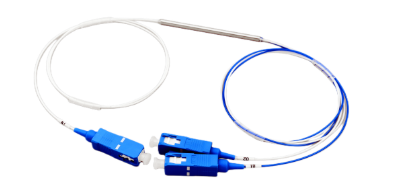
1*2 PM PLC
Its specifications are 1*2, size L47*M7*H4mm, headless