Fiber Bragg Grating Principle and Application

Fiber Bragg Grating Principle and Application
1. What is Fiber Bragg Grating?
Fiber Bragg Grating, referred to as FBG. The Bragg condition is a physical phenomenon that represents a condition in which light waves of a specific wavelength are strongly reflected when light waves propagate in periodic structures. This condition was discovered by Sir William Lawrence Bragg during X-ray crystallographic studies; hence, the name "Bragg condition". Since the working principle of fiber Bragg grating is based on the Bragg condition, that is, the light wave of a specific wavelength is strongly reflected in the optical fiber with periodic refractive index change, this kind of grating is named "fiber Bragg grating."
2. The principle of Fiber Bragg Grating
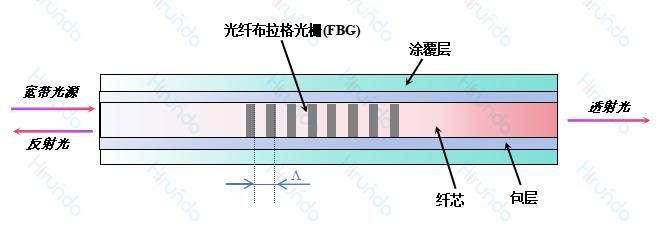
Fiber Bragg grating is different from plane grating. It is a kind of fiber grating. By using holographic interference technology or phase mask technology, the single-mode fiber core is laterally exposed to strong ultraviolet light with periodic patterns. In this process, strong exposure to ultraviolet light permanently changes the refractive index of the fiber core, producing a fixed refractive index modulation based on the exposure pattern. This fixed refractive index modulation is called a grating.
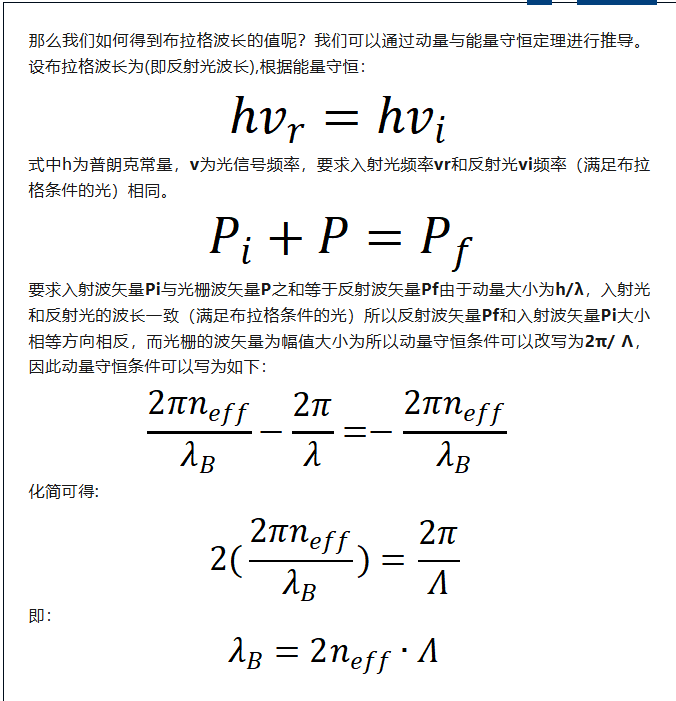
When the grating period is approximately half the wavelength of the incident light, all reflected light coherently combines into a beam of reflected light with a specific wavelength, which is called the Bragg condition. The wavelength at which incident light is reflected is called the Bragg wavelength. Optical signals of other wavelengths are almost unaffected by Bragg gratings and will continue to be transmitted through fiber gratings.
3. Application of Fiber Bragg Grating (FBG)
Due to their unique high precision, stability, miniaturization, and immunity to electromagnetic interference, Bragg gratings have shown great application potential in many fields.
Sensor application
As the core component of the sensor, FBG can be used to measure various physical parameters such as temperature, pressure, strain, acceleration, etc. In civil engineering, FBG sensors are used to monitor the structural health of bridges, dams, and buildings; in the oil and gas industry, they are used to monitor stress and temperature changes in pipelines; and in aerospace, FBG sensors can be integrated into the aircraft structure to monitor stress distribution during flight in real time.
Aerospace and Defense
FBG sensors can be embedded in the structures of aircraft, rockets, and other aircraft to monitor stress distribution in real time to ensure flight safety. They can be used to build smart fences and intrusion detection systems to improve the security protection of military bases and key facilities.
Manufacturing and Energy
FBG sensors can be integrated into smart factory equipment to realize real-time monitoring of the production process and optimize production efficiency and quality control. In the energy industry, in energy facilities such as wind power, solar energy, and nuclear energy, they can be used to monitor the operating status of equipment and prevent failures. occur.
4. Hirundo solution
Hirundo can provide you with a variety of solutions for different scenarios; please feel free to contact us!
Wavelength-stabilized laser
FBG can be used as a mirror in the laser cavity to provide wavelength-selective feedback to achieve single-wavelength laser output, which is crucial for a wavelength-stabilized laser source.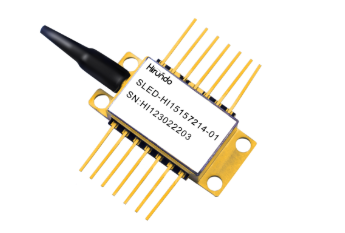
Dispersion compensation
Chirped FBG can be used to compensate for the dispersion effect in optical communication systems so that high-speed data signals remain clear after long-distance transmission.
Filters and switches
FBG can be used as a wavelength-selective filter or switch, playing a key role in dense wavelength division multiplexing (DWDM) systems to increase network capacity and flexibility.