
AI+FA fiber array: giving optical modules an intelligent brain for “micrometer-level alignment”

AI+FA fiber array: giving optical modules an intelligent brain for “micrometer-level alignment”
Types of FAs Hirundo can provide
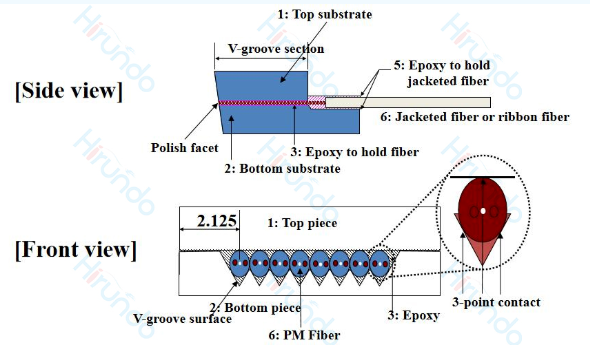
Polarization-maintaining FA: PM Fiber Array is an optical component made of multiple polarization-maintaining optical fibers fixed by a specific packaging process.
It has the characteristics of good polarization-maintaining performance, high arrangement accuracy, and strong stability.
In optical communications, it can transmit polarization-sensitive optical signals and cooperate with other devices to achieve complex functions.
in the field of optical fiber sensing, it is used to build high-precision sensors.
In laser technology, it is used as a key component to transmit and couple lasers.
It can improve system performance, facilitate integration, and has high reliability, playing an important role in many fields.
2. Polarization-maintaining MT-FA
MT-FA stands for Multi-Fiber Termination Fiber Array.
It is a component used in optical communications, consisting of multiple optical fibers arranged in an array.
and uses specific processes and structures to achieve fiber terminal connection and integration.
MT-FA is usually used to achieve parallel transmission of multiple optical signals.
It is a key component in high-speed, high-density optical transceiver modules.
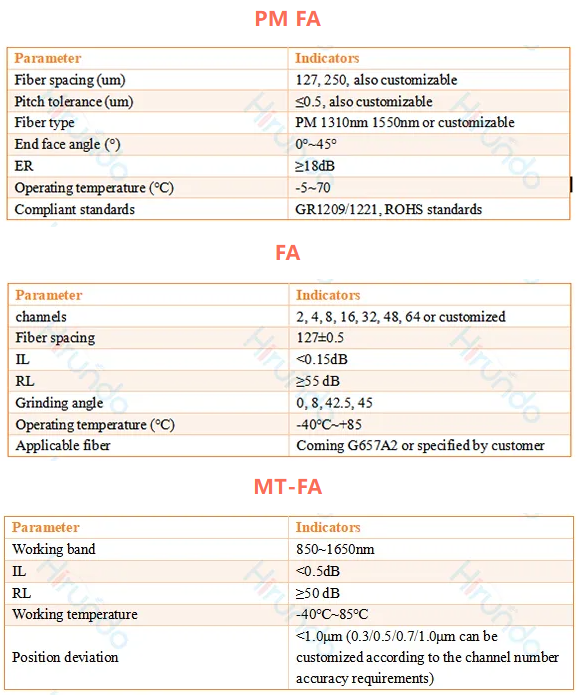
and can improve the transmission capacity and efficiency of optical communication systems.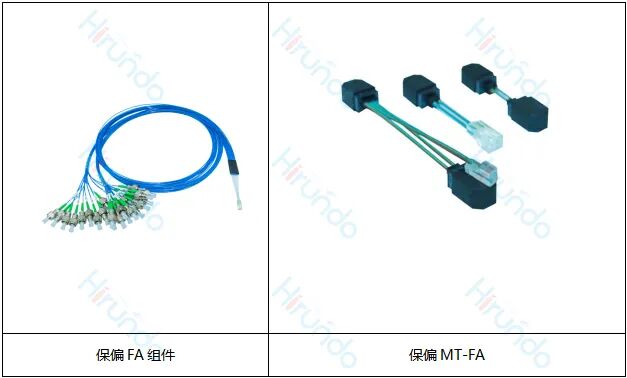
2. Interested Story
In a supercomputing center bidding, MT-FA was mocked by traditional single-mode FA because of its excessive number of cores and high density:
"Your cords are denser than human hair, so they must be easy to get tangled!"
MT-FA's revenge
That night, it secretly adjusted the optical path, causing all the data packets of the single-mode FA to take 8 detours before arriving;
Finally, the single-mode FA crashed, leaving a sentence in the log: "I was wrong; your core is 10 times stronger than mine..."
3. Application
The role of FA-MT in QSFP+ PSM4
(1) Efficient coupling of parallel optical signals
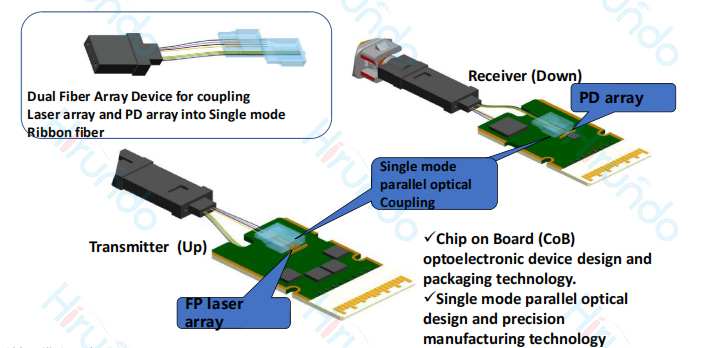
PSM4 uses 4-channel single-mode fiber parallel transmission (4×25G NRZ or 4×28G PAM4). FA-MT accurately aligns the VCSEL/PD array (optical chip) with the 4-core optical fiber.
Key indicators: Insertion loss (IL) < 1.5 dB (single channel)
Alignment error <0.5 μm
(2) High-density connection
FA-MT integrates MT ferrule (multi-core ceramic ferrule) to achieve compact arrangement of 4/8/12-core optical fibers in a limited space, adapting to the miniaturized design of QSFP+ modules.
(3) Environmental stability
The optical path deviation caused by temperature changes is reduced through metallized packaging or low CTE materials (such as glass substrates) to ensure long-term reliability.
Applied to 40G/100G active optical modules
(1) Efficient coupling of optical chips and optical fibers
Lasers (VCSEL/DFB/EML) or photodetectors (PD) need to be precisely connected to single-mode/multi-mode optical fibers through FA to achieve low-loss transmission of optical signals.
Typical insertion loss requirements:
40G SR4/PSM4: <1.5 dB (multimode)
100G LR4/ER4: <2.0 dB (single mode)
(2) Support for multi-channel parallel transmission
40G SR4: 4×10G multimode fiber (MMF) + FA (4 cores)
100G PSM4: 4×25G single-mode fiber (SMF) + FA-MT (4-core MT ferrule)
100G CWDM4: 4×25G wavelength multiplexing + FA (single-core input, 4-wavelength output)
(3) Miniaturization and high-density integration
FA uses micron-level V-grooves or silicon-based precision waveguides to achieve multi-fiber arrangement in a limited space and is suitable for compact packages such as QSFP+/OSFP.