
With the rapid development of cloud computing, artificial intelligence and other technologies, the demand for bandwidth, density and Reliability in data centers continues to increase. This paper systematically analyzes the technical path and application practice of modern data center solutions around core products such as optical modules, MPO patch cords, and high-density cabling, combined with other passive devices.
1. Technical analysis of core products
Optical transceivers: the cornerstone of high-speed transmission
As the core component of data center networks, optical modules continue to accelerate their technological iterations:
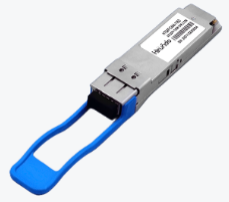
High Rate and Low Latency: 400G/800G optical transceivers achieve single-channel 100G transmission through PAM4 modulation technology, and silicon photonics technology (SiPh) reduces power consumption by 50% and size by 60%.
Intelligence and compatibility: Optical modules that support the CMIS protocol can remotely monitor temperature, optical power, and other parameters, and automatically adapt to multi-manufacturer devices. CPO (Optoelectronic Co-Packaging) technology integrates the optical engine with the switching chip, reducing latency by 30%.
MPO Patch Cords: A Revolution in High-Density Connectivity MPO patch cords solve space bottlenecks through multi-core integrated design:
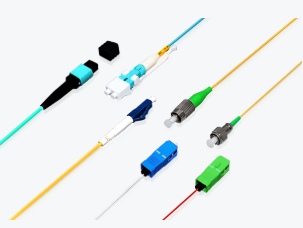
Density and Efficiency:
A single MPO patch cord supports 12/24/48-core fibers, which is 8 times higher than the wiring density of traditional LC
patch cords. The push-pull locking mechanism is used to increase deployment speed by 70%.
Application scenarios:
Suitable for interconnection between data center cabinets (40G/100G QSFP), storage area network (SAN), and mesh
networking of supercomputing clusters.
High-Density Cabling System: Balance space and performance
Pre-termination technology:
The factory-prefabricated MPO backbone fiber optic cable is directly connected to the distribution frame, reducing the on-site splicing time by 80%.
Intelligent management:
High-density patch panels (such as MRJ21) support hybrid deployment of 10,000 gigabit copper and fiber optics, increasing cabinet space utilization by 40%.
2. Supporting passive device expansion scheme
Fiber Optic Splitter and Wavelength Division Multiplexer (WDM)
The 1×N fiber splitter realizes passive splitting of monitoring signals, with an insertion loss < 0.3 dB.
CWDM/DWDM multiplexer extends the single-fiber capacity to 96 waves and supports long-distance interconnection between data centers.
Light attenuators and annular devices
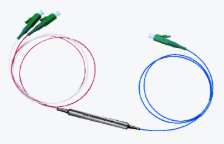
The adjustable optical attenuator (VOA) has an accuracy of ±0.1 dB for optical power equalization;
the Faraday rotary ring has a reverse isolation of > 40 dB, protecting the laser from reflection damage.
High-density fiber optic wiring system
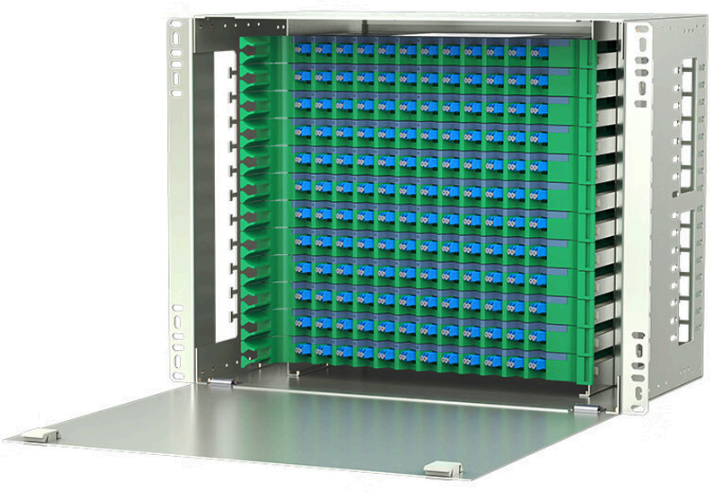
The modular ODF frame supports 576-core fiber management and is equipped with MPO-LC adapter panels for flexible jumping.
3. Typical solutions and application cases
Ultra-large-scale AI cluster networking
A leading cloud computing center uses 400G QSFP-DD optical module and
a 48-core MPO backbone to build an all-optical mesh network with a
single-rack switching capacity of 1.6 Pbps and a latency of less than 2 μs.
Active-active data center disaster recovery
Cross-regional 100G wavelength multiplexing is achieved through DWDM devices.
and optical channel protection loops (OLPs) are built with MPO patch cords, with a failover time of < 50 ms.
Green and energy-saving practices
Using liquid-cooled optical modules and low-loss MPO patch cords,
combined with intelligent power distribution units (PDUs) ,
the PUE value of the data center is reduced from 1.5 to 12.
4. Future technology trends
Deep integration of silicon optics and CPO:
1.6T silicon optical modules are expected to be commercialized in 2026, and CPO technology
shortens the distance between the optical engine and the switching chip to millimeters, reducing power consumption by another 40%.
L++ band expansion: supports ultra-wideband WDM devices from 1575 to 1625 nm, with a single fiber capacity of more than 64 Tbps.
Intelligent O&M:
Optical fiber sensing technology monitors wiring micro-bending losses in real time.
and AI algorithms predict faults and automatically switch routes.
Summary:
Modern data center solutions take optical modules and MPO patch cords as the core. combined with passive devices such as wavelength division multiplexing and intelligent wiring to
Build a high-bandwidth, low-latency, and easily scalable infrastructure.With the maturity of silicon photonics technology and intelligent management,Data centers will continue to evolve in a more efficient and green direction.