
With the rapid development of 5G, cloud computing, and other technologies, the demand for ultra-large bandwidth, low latency,
and Flexible scheduling in backbone networks has surged.
OTN/WDM technology has become the core bearing solution of modern backbone
networks due to its high capacity, long-distance transmission, and intelligent management capabilities.
As a manufacturer of fiber optic passives, we provide key foundational components for OTN/WDM systems through technological innovation,
helping to build efficient and reliable transmission networks.
1. OTN/WDM architecture and passive device integration
The backbone OTN/WDM system adopts a hierarchical architecture (optical channel layer OCh, optical multiplexing segment layer OMS,
optical transmission segment layer (OTSL), in which passive devices play an irreplaceable role in optical layer signal processing:
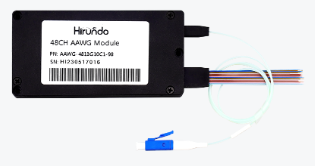
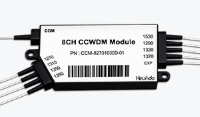
Wavelength Division Multiplexer (WDM):
Supports DWDM/CWDM technology to achieve transmission of more than 96 waves per fiber
(Channel spacing can be customized by 0.8 nm/20 nm
achieves insertion loss of <0.3 dB and wavelength isolation of >35dB through a precision optical coating process.)
Optical isolator:
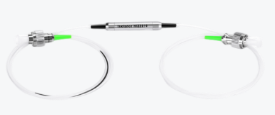
Adopts Faraday rotating magneto-optical crystal technology to achieve > 40 dB reverse isolation degree,
effectively preventing reflection damage from active devices such as EDFA.
Optical Splitter:
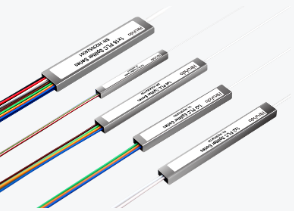
1×N splitter ratio accuracy of ±0.5 dB, supports wavelength-independent splitting,
and is suitable for optical power monitoring and service protection switching scenarios.
2. Technological breakthroughs in passive devices
In response to the ultra-long-distance transmission needs of backbone networks, our products have achieved breakthroughs in the following:
Anti-nonlinear design:
By optimizing the radius of curvature of the fiber end-face microlens (<5 μm), the four-wave mixing effect in high-power
scenarios is reduced, and 400G QPSK/16QAM modulated signal transmission is supported.
Wide temperature stability:
The operating temperature range is extended to -40°C~85°C to meet the deployment needs of field optical relay stations.
Intelligent integration:
Develop hybrid passive devices (such as WDM + isolator + beam splitter 3-in-1 module) to reduce the size by 60% and
adapt to the high-density deployment of OXC all-optical switching equipment.
3. Application advantages in OTN/WDM system
Improve network reliability
The optical channel protection ring (OLP) is constructed through the ring device.
and with the 1+1 optical path redundancy design, it realizes
For example, in an 80km 400G system,
the polarization-related loss (PDL) of passive devices is controlled at <0.1 dB to ensure business continuity.
The WSS wavelength selector switch of the preset fiber collimator supports remote reconstruction of wavelength routing.
replacing the traditional ODF manual fiber hopping.
Actual measurements show that this solution can reduce O&M man-hours by 30%.
Optimize transmission performance
In ultra-C-band (1525-1568nm) extended applications, our ultra-wideband WDM devices support the THz spectrum range with
increased single-fiber capacity to 64 Tbps,
while reducing deployment costs with G.652/G.655 fiber-compatible designs.
4. Successful application cases
An operator's backbone network upgrade project: Using a 96-wave DWDM+OTN electrical crossover solution, it deploys high-density fiber
loopers (IL < 1.2 dB) and dimmable optical attenuators (adjustment accuracy ± 0.1 dB) to achieve cross-provincial 4,000 km 200G service bearing.
Data Center Interconnection (DCI):
Build an all-optical mesh network with silicon-based hybrid integrated devices that support 1.6 Pbps switching capacity and reduce power consumption by 45%.
5. Future technology direction
For 1.6 Tbps coherent transmission requirements, we are developing: Ultra-low loss coupler based on photonic crystal fiber (theoretical loss < 0.05 dB)
The expandable WDM module supports the L++ band (1575-1625 nm).
The intelligent optical device has built-in optical power/OSNR monitoring function
This article analyzes the key technical path of passive components in the OTN/WDM backbone network from the perspective of device manufacturing.